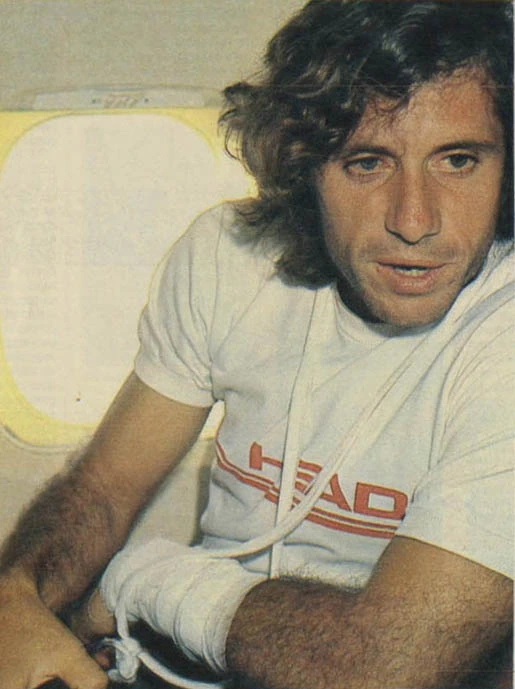
The most reliable estimate for Guillermo Vilas's net worth sits somewhere between $4 million and $20 million, with the mid-range around $8 to $10 million being the most defensible figure given publicly available information. His documented career prize money of $4,923,882 (per the ATP Media Guide) forms the hard floor of any serious estimate, but endorsements, appearance fees, exhibition income, and ongoing business ventures like the Vilas Tennis Academy push the realistic total considerably higher. Any figure below $4 million ignores verified on-court earnings, and any claim of $40 million or more lacks documented support.
Guillermo Vilas Net Worth: Rango y Cómo Verificarlo

Ricardo Sandoval
1 May 2026
What the numbers actually look like

When you search for Guillermo Vilas's net worth, you'll find a chaotic range of figures. Some sites say $100,000 to $1 million. Others say $20 million, or even $40 million in an FAQ section. One AI-driven aggregator puts it at $4.1 million for 2024 and $4.55 million for 2025. SurpriseSports estimates $1 to $2 million. That's not a small spread, it spans two orders of magnitude, and it tells you more about the methodology of each site than about Vilas himself. Because the phrase “pita de la vega net worth” is often used in searches, you may be seeing numbers that are built with the same kinds of guesswork and inconsistent methodology.
| Source | Estimate | Methodology note |
|---|---|---|
| ATP Media Guide (official) | $4,923,882 career prize money | Verified on-court earnings only, no off-court income |
| CelebsMoney / CollegeNetWorth | $100K – $1M | Formula-based, no documented income breakdown |
| SurpriseSports | $1M – $2M | Category ranking, no detailed methodology |
| PeopleAI | $4.1M – $4.55M | Digital signal modeling, not financial statements |
| CineNetWorth | ~$20M (FAQ mentions $40M) | Aggregated estimate, sourcing unclear |
| This site's editorial range | $4M – $20M (mid-range ~$8–10M) | Prize money base + documented income streams + era adjustment |
The wide variation comes down to three things: different starting assumptions about off-court income, whether or not the estimator adjusts for inflation, and whether anyone actually dug into his business activities. The sites showing $100K to $1M are almost certainly using a purely algorithmic formula that ignores historical context entirely. The sites showing $40 million are almost certainly extrapolating without documented evidence.
How Vilas built his fortune
Guillermo Vilas was one of the dominant players of the mid-to-late 1970s. He won four Grand Slam titles (the 1977 French Open, 1977 US Open, and the 1978 and 1979 Australian Open), reached a world No. 2 ranking, and in 1977 posted one of the most remarkable single-season records in open-era tennis: 16 titles and 145 match wins. That sustained excellence at the top of the game was the engine of his wealth, but the money came from multiple directions.
On-court prize money

His verified career prize total is $4,923,882. That number comes from the ATP's own records and is the single most reliable data point in any Vilas wealth discussion. It's the floor, not the ceiling. It also reflects prize money structures that were significantly lower than today's, particularly in the early and mid-1970s when the open era was still relatively young and purses were a fraction of current levels.
Endorsements and equipment deals
Vilas was one of the first major Latin American tennis stars with global marketing appeal, and he attracted brand partnerships accordingly. HEAD has a documented association with elite players going back decades and Vilas appears in that tradition, though specific deal values from the 1970s and 1980s are not publicly disclosed. Endorsement income for a top-5 player during his era could reasonably add hundreds of thousands of dollars per year, though nothing approaching the multi-million-dollar annual deals that today's top players command.
Appearance fees and exhibition income

This is an important and often overlooked piece of the puzzle. In 1983, Vilas was suspended for one year and fined $20,000 by the Men's International Professional Tennis Council after his manager Ion Tiriac accepted approximately $60,000 in appearance money from promoters for Vilas to play a tournament in Rotterdam. Vilas contested whether he personally accepted the money, but the episode documents that appearance fees in that range were a real income stream for top players of his era, and that they existed largely outside the formal prize money records. Exhibition matches, which weren't tracked on the official circuit, added further income throughout his career.
Post-career business ventures
Vilas's off-court footprint is meaningful and ongoing. He co-founded the Vilas Tennis Academy, which operates programs in Mallorca and Punta Cana with weekly year-round camps. Una página informativa de Vilas Tennis Academy (Sport Academies / SPAIN) describe que la academia con sede en Mallorca es dirigida o representada por Guillermo Vilas y aporta contexto sobre su operación para campamentos y entrenamiento [Vilas Tennis Academy, que opera programas en Mallorca y Punta Cana](https://www.
sport-academies. com/en/academy/vilas-tennis-academy/). This is confirmed by the GPTCA directory and covered in Spanish sports media including AS. com.
Around 2011, he also launched his own tennis ball brand, a move covered by the Argentine business press. Neither business publishes financial statements, so exact revenue figures aren't available, but the combination of a running academy with international locations and a branded product line suggests meaningful ongoing income beyond his playing days.
Earnings timeline: when the money came in
Understanding when Vilas earned what matters a lot for any honest net worth estimate, especially because dollar values from the 1970s don't translate directly to 2026 purchasing power.
- Early career (1969–1973): Limited prize money during the transitional years of the open era. Prize purses were small by modern standards, though ranking and reputation were building.
- Peak years (1974–1979): The core earning window. His 1977 season alone — 16 titles, two Grand Slams — would have generated the largest share of his on-court prize money. Endorsement deals and appearance fees were also at their highest during this window.
- Continued competition (1980–1988): Vilas remained competitive through the 1980s, adding more prize money and exhibition income, though he was no longer dominating at the same level. The 1983 suspension cost him one year of competition and likely significant appearance fee income.
- Post-career (1989–present): Income shifted to endorsements, the tennis academy, the ball brand, and personal appearances. No salary disclosures are public, but the academy's multi-location operation suggests ongoing commercial revenue.
On the inflation question: the U.S. Bureau of Labor Statistics CPI calculator is the standard tool for converting historical dollar figures. A dollar earned in 1977 is worth roughly four to five times that amount in 2026 dollars depending on the exact conversion. That means his $4.9 million in career prize money, earned mostly between the mid-1970s and mid-1980s, represents something closer to $15 to $20 million in today's purchasing power when adjusted. That context is why the $4 to $20 million range is more credible than a $1 million floor.
How net worth estimates are actually built
No public financial statement exists for Guillermo Vilas. He is not a publicly traded company. His tax filings, bank accounts, and asset holdings are private. That means every net worth figure you see, including ours, is an estimate built from observable proxies.
The approach this site uses starts with verified income floors: in Vilas's case, the $4,923,882 in career prize money from the ATP Media Guide. From there, documented income streams (endorsements with named brands, the tennis academy as an operating business, the ball brand launch) are layered in as reasonable additions. Inflation adjustment is applied to convert historical earnings to a current-dollar basis. The result is a range rather than a single number because the private portions of his assets, real estate, investments, savings, business equity, genuinely cannot be verified.
Sites that show very low estimates (under $1 million) typically skip the inflation adjustment and ignore all non-prize-money income. Sites that show very high estimates ($40 million) typically don't document their reasoning. Neither extreme is useful.
How his net worth has shifted over time
Wealth estimates for retired athletes like Vilas don't stay static. In the years immediately following his peak playing career, his net worth was likely at or near its highest point: prize money and endorsement income had accumulated, and costs of running a post-career business hadn't yet started. Through the 1990s and 2000s, wealth trajectory would have depended heavily on investment decisions and the performance of his business ventures, neither of which is documented publicly.
The tennis academy, if profitable, adds to wealth over time. The ball brand, if it scaled, adds further. On the other side, running international operations involves real costs: staffing, facilities, travel. Without financial disclosures, the direction of his net worth since retiring from competition is genuinely uncertain, which is why estimates from 2024 and 2025 vary as much as they do. The most honest position is that the base built during his playing career was substantial and that ongoing businesses either maintain or modestly grow it, putting the current figure in the $5 to $15 million range as the most defensible working estimate.
Legacy, awards, and off-court roles that shaped his financial story
Vilas was inducted into the International Tennis Hall of Fame, and his legacy in Latin American tennis is foundational, he was the first major Latin American player to dominate the global game. That legacy has direct financial value: it makes his name commercially viable decades after retirement, supports the academy's marketing, and explains why he continues to receive invitations to events, exhibitions, and media appearances. His ranking recognition has been a long-running topic in tennis history circles, with many arguing he deserved the world No. 1 ranking in 1975 based on match results, a debate that keeps his profile active in tennis media without requiring him to still compete.
The Vilas Tennis Academy operating in both Mallorca and Punta Cana signals something important: his name still carries commercial weight in markets where tennis instruction is a premium service. The GPTCA's confirmation of his role as co-founder, and the AS.com coverage of his Mallorca operation, are useful data points for estimating that his post-career income is real, even if it's not quantified in public records.
Why the numbers you find online differ so much

This is worth addressing directly because it's the main source of confusion when people search for Vilas's net worth. If you're specifically trying to pin down Mayi de la Vega net worth, the same approach of verifying income streams and questioning unsupported claims applies Vilas's net worth. There are at least five reasons the numbers vary so widely.
- No primary source exists. Vilas has never published a personal financial statement. Every estimate is derived, not reported.
- Different methodologies produce wildly different outputs. A formula that estimates wealth based purely on Wikipedia traffic and social media signals will reach a different number than one that starts with ATP prize money records and applies inflation adjustments.
- Inflation is often ignored. Sites that report his career earnings in nominal dollars without adjusting to current purchasing power systematically understate the real value of money earned in the 1970s.
- Off-court income is nearly impossible to estimate without leaks or disclosures. Endorsement deals, appearance fees, and business revenue from the academy are not in any public registry.
- Old estimates circulate indefinitely. A figure calculated in 2010 gets copied and re-published in 2024 without updating for inflation, new business activity, or changed circumstances.
How to verify (or challenge) any estimate you find
If you want to sanity-check a Vilas net worth figure you found somewhere, here's a practical checklist. Because those figures can be conflated across different athletes and websites, it helps to verify each person separately when looking at Artemio de la Vega net worth claims.
- Start with the ATP prize money figure ($4,923,882) as the documented floor. Any estimate below this number, expressed in current dollars, is almost certainly wrong.
- Check whether the source applies any inflation adjustment. If a 2026 article quotes his career earnings in raw 1970s dollars without conversion, treat the figure skeptically.
- Look for methodology transparency. Does the source explain how it reached its number? If not, it's likely a copied or algorithmically generated estimate.
- Cross-check across at least three independent sources and note where they agree and diverge. Consensus around a range (rather than a single number) is more reliable than a precise single figure from one site.
- Red flags: any claim of $40 million or more without documented assets or disclosed financial statements; any estimate under $2 million that ignores inflation-adjusted prize money; and any site that presents a single exact figure (like '$12,500,000') as if it were verified — wealth estimates for private individuals are always ranges.
- For business activities, look for journalism from outlets like AS.com, iProfesional, or the GPTCA directory to confirm that his academy and other ventures are real and operating, even if revenues aren't disclosed.
If you're researching other Argentine or Latin American sports and entertainment figures for comparison, the same methodology applies: start with documented career earnings, layer in verified business activities, apply inflation, and express the result as an honest range. If you are also checking Daniel de la Vega net worth, use the same approach: start with verifiable income signals, then add business and endorsement context where it is documented. That approach keeps estimates grounded and avoids the dramatic swings you see on less careful aggregator sites.
FAQ
Why do some sites show Guillermo Vilas net worth as low as $1 million?
Those numbers usually come from using only prize money (or even skipping inflation entirely) and then ignoring off-court income like the academy, exhibitions, and endorsements. If the estimate does not name specific income sources or use a historical-to-current-dollar method, treat it as an incomplete lower bound rather than a true valuation.
What is the single most important number to anchor a Guillermo Vilas net worth estimate?
His verified career prize money total of $4,923,882. Any credible estimate should start from that floor, then explain additional layers (endorsements, appearance fees, exhibitions, academy operations, and the ball brand) and clarify whether it adjusts for inflation.
How should I interpret “inflation adjusted” net worth versus “current dollars” estimates?
Inflation adjustment should convert the historical earnings base to today’s purchasing power using a consistent CPI method. If a site claims inflation adjustment but does not state the conversion basis (for example, which CPI series or which year midpoint), the resulting number can be misleading even if it looks more precise.
Can Guillermo Vilas net worth be higher than $20 million based on the article’s logic?
It is possible, but you would need credible evidence of substantial retained business equity or large-scale profits from later ventures. Without financial statements, the most defensible range stays conservative, typically around the $5 to $15 million working estimate mentioned, because ongoing revenue is real but costs and private investment details are not disclosed.
Why do “AI net worth calculators” often disagree so much on Guillermo Vilas net worth?
They commonly use generic athlete templates, inconsistent assumptions about endorsement size, and sometimes unrealistic growth rates for post-career business. When the output varies by two orders of magnitude, it is usually less about Vilas and more about the calculator’s rules and how it treats missing data.
Does the one-year suspension and fine in 1983 affect net worth estimates today?
Not directly as a solvable deduction, but it supports an important data point: appearance fees outside official prize money could be significant. That means some estimators that ignore appearance income tend to understate total earnings, even if the specific $20,000 fine itself is small relative to a long career.
Should I treat the Vilas Tennis Academy revenue as guaranteed profit for Guillermo Vilas net worth?
No. Coaching academies have substantial operating costs (staff, facilities, travel, and year-round programming). The existence and expansion to locations like Mallorca and Punta Cana supports meaningful income potential, but profitability and his ownership stake determine how much translates into personal net worth.
Are endorsement deals documented for Guillermo Vilas well enough to verify net worth?
Brand association and historical participation are documented, but specific deal values from the 1970s and 1980s are not publicly disclosed. A credible approach therefore treats endorsements as an estimated add-on (often “hundreds of thousands per year” for that era for top players) rather than a provable number.
How can I sanity-check a Guillermo Vilas net worth figure I find online in under five minutes?
Check whether the estimate (1) anchors on the $4,923,882 verified prize total, (2) states an inflation approach for 1970s earnings, and (3) mentions at least two non-prize income categories, such as endorsements, exhibitions, appearance fees, academy operations, or the ball brand. If those elements are missing, downgrade confidence.
Did Guillermo Vilas likely reach his peak net worth soon after retirement?
The most likely pattern, given the article’s reasoning, is that wealth peaked relatively close to the end of his playing prime because prize and sponsorship income were higher and business costs had not yet fully ramped. After that, investment returns and business profitability became the main drivers, but both are private and therefore hard to quantify.
Next Article
Fernando Valenzuela Net Worth at Death: How to Verify
Cómo verificar el patrimonio neto de Fernando Valenzuela al fallecer: fuentes, método y cómo conciliar cifras.